单选题 (共 30 题 ),每题只有一个选项正确
设函数 $f(x), g(x)$ 在 $x=0$ 的某去心邻域内有定义且恒不为零.若当 $x \rightarrow 0$ 时, $f(x)$ 是 $g(x)$ 的高阶无穷小,则当 $x \rightarrow 0$ 时,( )。
$\text{A.}$ $f(x)+g(x)=o(g(x))$
$\text{B.}$ $f(x) g(x)=o\left(f^2(x)\right)$
$\text{C.}$ $f(x)=o\left( e ^{g(x)}-1\right)$
$\text{D.}$ $f(x)=o\left(g^2(x)\right)$
设函数 $f(x)$ 连续,给出下列四个条件:
(1) $\lim _{x \rightarrow 0} \frac{|f(x)|-f(0)}{x}$ 存在;
(2) $\lim _{x \rightarrow 0} \frac{f(x)-|f(0)|}{x}$ 存在;
(3) $\lim _{x \rightarrow 0} \frac{|f(x)|}{x}$ 存在;
(4) $\lim _{x \rightarrow 0} \frac{|f(x)|-|f(0)|}{x}$ 存在;
其中能得到"$f(x)$ 在 $x=0$ 处可导"的条件个数是( )。
$\text{A.}$ 1
$\text{B.}$ 2
$\text{C.}$ 3
$\text{D.}$ 4
设 $f(x)$ 具有任意阶可导,且 $f^{\prime}(x)=[f(x)]^2$ ,则 $f^{(n)}(x)=$ .
$\text{A.}$ $n![f(x)]^{n+1}$
$\text{B.}$ $n[f(x)]^{n+1}$
$\text{C.}$ $n![f(x)]^{2 n}$
$\text{D.}$ $n[f(x)]^{2 n}$
$\int_0^1 \int_{y-1}^{1-y} f(x, y) d x d y=$
$\text{A.}$ $\int_{-1}^0 \int_0^{x+1} f(x, y) d x d y+\int_0^1 \int_0^{1-x} f(x, y) d x d y$
$\text{B.}$ $\int_0^1 d x \int_0^x f(x, y) d y$
$\text{C.}$ $\int_{-1}^1 \int_0^1 f(x, y) d x d y$
$\text{D.}$ $\int_0^1 \int_0^{2-x} f(x, y) d x d y$ .
设曲面 $\sum$ 是球面 $x^2+y^2+z^2=1$ ,区域 $\Omega$ 是由 $x^2+y^2+z^2=1$ 所围成的闭区域,下列计算正确的是
(1) $\iiint_{\Omega}\left(x^2+y^2+z^2\right) d x d y d z=\iiint_{\Omega} d x d y d z$ ;
(2) $\iint_{\Sigma}\left(x^2+y^2+z^2\right) d S=\iint_{\Sigma} d S$ .
$\text{A.}$ (1)对
$\text{B.}$ (2)对
$\text{C.}$ (1)(2)都对
$\text{D.}$ (1)(2)都错
极限 $\lim _{x \rightarrow 0} \frac{[\sin x-\sin (\sin x)] \sin x}{x^4}$ 为( )。
$\text{A.}$ $\frac{1}{3}$
$\text{B.}$ $-\frac{1}{3}$
$\text{C.}$ $\frac{1}{6}$
$\text{D.}$ $-\frac{1}{6}$
利用泰勒公式,当 $x \rightarrow 0$ 时,$f(x)=1-\cos x \cos 2 x \cos 3 x$ 的等价无穷小为( )。
$\text{A.}$ $5 x^2$
$\text{B.}$ $7 x^2$
$\text{C.}$ $-5 x^2$
$\text{D.}$ $-7 x^2$
利用夹逼准则,极限 $\lim _{n \rightarrow \infty} \int_0^1 \frac{x^n}{1+x} d x$ 为( )
$\text{A.}$ 0
$\text{B.}$ $\frac{1}{4}$
$\text{C.}$ $\frac{1}{2}$
$\text{D.}$ 1
设有直线 $L:\left\{\begin{array}{l}x+3 y+2 z+1=0 \\ 2 x-y-10 z+3=0\end{array}\right.$ 及平面 $\Pi: 4 x-2 y+z-2=0$ ,则直线 $L$()
$\text{A.}$ 平行于平面
$\text{B.}$ 在平面上
$\text{C.}$ 垂直于平面
$\text{D.}$ 与平面斜交
直线 $\left\{\begin{array}{l}\frac{x-1}{1}=\frac{z+2}{2}, \\ y=0\end{array}\right.$ 上与点 $(2,1,-3)$ 最近的点是
$\text{A.}$ $(1,0,-2)$ .
$\text{B.}$ $\left(\frac{4}{5}, 0,-\frac{12}{5}\right)$ .
$\text{C.}$ $(2,0,0)$ .
$\text{D.}$ $\left(\frac{3}{2}, 0,-1\right)$
曲面 $x^2+\cos (x y)+y z+x=0$ 在点 $(0,1,-1)$ 处的切平面方程为
$\text{A.}$ $x-y+z=-2$ .
$\text{B.}$ $x+y+z=0$ .
$\text{C.}$ $x-2 y+z=-3$ .
$\text{D.}$ $x-y-z=0$ .
设曲面 $\Sigma$ 为柱面 $x^2+y^2=1$ 介于 $z=-2$ 和 $z=2$ 之间的一部分,则曲面积分
$$
\iint_{\Sigma}\left(x^2+y z+y^2\right) d S=\left[\begin{array}{ll} \end{array}\right]
$$
$\text{A.}$ $2 \pi$ .
$\text{B.}$ $4 \pi$ .
$\text{C.}$ $6 \pi$ .
$\text{D.}$ $8 \pi$ .
设 $f(x)$ 是以 $2 \pi$ 为周期的周期函数,且 $f(x)=\left\{\begin{array}{ll}\cos x, & 0 \leq|x| < \frac{\pi}{2}, \\ \sin x, & \frac{\pi}{2} \leq|x| \leq \pi,\end{array}\right.$ 则它的傅里叶级数在 $x=\frac{3 \pi}{2}$ 处收敛于
$\text{A.}$ 1 .
$\text{B.}$ -1 .
$\text{C.}$ $\frac{1}{2}$ .
$\text{D.}$ $-\frac{1}{2}$ .
设有两个数列 $\left\{a_n\right\}_{n=1}^{\infty},\left\{b_n\right\}_{n=1}^{\infty}$ ,若 $\lim _{n \rightarrow \infty} a_n=0$ ,则
$\text{A.}$ 当 $\sum_{n=1}^{\infty} b_n$ 收敛时,$\sum_{n=1}^{\infty} a_n b_n$ 收敛.
$\text{B.}$ 当 $\sum_{n=1}^{\infty} b_n$ 发散时,$\sum_{n=1}^{\infty} a_n b_n$ 发散.
$\text{C.}$ 当 $\sum_{n=1}^{\infty}\left|b_n\right|$ 收敛时,$\sum_{n=1}^{\infty} a_n^2 b_n^2$ 收敛.
$\text{D.}$ 当 $\sum_{n=1}^{\infty}\left|b_n\right|$ 发散时,$\sum_{n=1}^{\infty} a_n^2 b_n^2$ 发散.
设 $\lim _{x \rightarrow \infty} \frac{(x-4)^{95}(a x-3)^5}{\left(x^2+5\right)^{50}}=32$ ,则 $a$ 的值为 .
$\text{A.}$ 1
$\text{B.}$ 2
$\text{C.}$ $\sqrt[5]{8}$
$\text{D.}$ 无法求出
当 $x \rightarrow 0$ 时,$\frac{1}{x^2} \sin \frac{1}{x}$ 是( ).
$\text{A.}$ 无穷小
$\text{B.}$ 无穷大
$\text{C.}$ 有界的,但不是无穷小的
$\text{D.}$ 无界的,但不是无穷大的
函数 $f(x)=\sin (x-2) \cdot \sin (x-4) \cdot\left|(x-1)(x-2)^2(x-3)^3(x-4)^4\right|$ 不可导点的个数是
$\text{A.}$ 1
$\text{B.}$ 2
$\text{C.}$ 3
$\text{D.}$ 0
已知 $f(x)=\left\{\begin{array}{ll}\frac{2}{3} x^3, & x \leq 1, \\ x^2, & x>1,\end{array}\right.$ 则 $f(x)$ 在 $x=1$ 处的 .
$\text{A.}$ 左、右导数都存在
$\text{B.}$ 左导数存在,右导数不存在
$\text{C.}$ 左导数不存在,右导数存在
$\text{D.}$ 左、右导数都不存在
设函数 $f(x)$ 在 $(-\infty,+\infty)$ 内连续,其导函数的图形如图所示,则
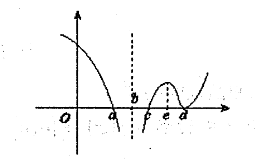
$\text{A.}$ 函数 $f(x)$ 有 2 个极值点,曲线 $y=f(x)$ 有 2 个拐点.
$\text{B.}$ 函数 $f(x)$ 有 2 个极值点,曲线 $y=f(x)$ 有 3 个拐点.
$\text{C.}$ 函数 $f(x)$ 有 3 个极值点,曲线 $y=f(x)$ 有 1 个拐点.
$\text{D.}$ 函数 $f(x)$ 有 3 个极值点,曲线 $y=f(x)$ 有 2 个拐点.
当 $x>0$ 时,曲线 $y=x \sin \frac{1}{x}()$ .
$\text{A.}$ 有且仅有水平渐近线
$\text{B.}$ 有且仅有垂直渐近线
$\text{C.}$ 既有水平渐近线又有垂直渐近线
$\text{D.}$ 既无水平渐近线也无垂直渐近线
设 $f(x)=\left\{\begin{array}{cc}\cos x, & x \geq 0 \\ \sin x, & x < 0\end{array}, g(x)=\left\{\begin{array}{cc}x \sin \frac{1}{x}, & x \neq 0 \\ 0, & x=0\end{array}\right.\right.$ 那么在区间 $(-1,1)$ 内
$\text{A.}$ $f(x)$ 与 $g(x)$ 都存在原函数
$\text{B.}$ $f(x)$ 与 $g(x)$ 都不存在原函数
$\text{C.}$ $f(x)$ 存在原函数,$g(x)$ 不存在原函数
$\text{D.}$ $f(x)$ 不存在原函数,$g(x)$ 存在原函数
如果 $\sin x+x \cos x$ 是 $f(x)$ 的一个原函数,则 $\int f^{\prime}(x) d x=$ .
$\text{A.}$ $-x \sin x+2 \cos x+C$
$\text{B.}$ $\sin x-x \cos x+C$
$\text{C.}$ $\sin x+x \cos x+C$
$\text{D.}$ $-\sin x-x \cos x+C$
设 $I=\int_{\frac{\pi}{6}}^{\frac{\pi}{4}} \ln \sin x d x, \quad J=\int_{\frac{\pi}{6}}^{\frac{\pi}{4}} \ln \cot x d x, \quad K=\int_{\frac{\pi}{6}}^{\frac{\pi}{4}} \ln \cos x d x$ ,则 $I, J, K$ 的大小关系为
$\text{A.}$ $I < J < K$
$\text{B.}$ $I < K < J$
$\text{C.}$ $J < I < K$
$\text{D.}$ $K < J < I$
交换积分次序,则二次积分 $\int_0^1 d y \int_y^{\sqrt{y}} f(x, y) d x=(\quad)$ .
$\text{A.}$ $\int_0^1 d x \int_{\sqrt{x}}^x f(x, y) d y$
$\text{B.}$ $\int_0^1 d x \int_x^{\sqrt{x}} f(x, y) d y$
$\text{C.}$ $\int_0^1 d x \int_{x^2}^x f(x, y) d y$
$\text{D.}$ $\int_0^1 d x \int_x^{x^2} f(x, y) d y$
设常数 $k>0$ ,则级数 $\sum_{n=1}^{\infty}(-1)^n \frac{k+n}{n^2}$
$\text{A.}$ 发散
$\text{B.}$ 绝对收敛
$\text{C.}$ 条件收敛
$\text{D.}$ 收敛或发散与 $k$ 的取值有关
设 $\alpha$ 为常数,则级数 $\sum_{n=1}^{\infty}\left(\frac{\sin n \alpha}{n^2}-\frac{1}{\sqrt{n}}\right)$
$\text{A.}$ 绝对收敛
$\text{B.}$ 条件收敛
$\text{C.}$ 发散
$\text{D.}$ 收敛性与 $\alpha$ 的取值有关
下列选项正确的是( )
$\text{A.}$ $\lim _{(x, y) \rightarrow(0,0)} x \cos \frac{1}{y}=0$ ;
$\text{B.}$ $\lim _{(x, y) \rightarrow(0,0)} x \cos \frac{1}{y}=\lim _{x \rightarrow 0} \lim _{y \rightarrow 0} x \cos \frac{1}{y}$ ;
$\text{C.}$ $\lim _{x \rightarrow 0} \lim _{y \rightarrow 0} x \cos \frac{1}{y}=\lim _{y \rightarrow 0} \lim _{x \rightarrow 0} x \cos \frac{1}{y}$ ;
$\text{D.}$ $\lim _{y \rightarrow 0} \lim _{x \rightarrow 0} x \cos \frac{1}{y}=1$ .
函数 $u=\cos \left(x^2+y^2+z^2\right)$ 在点 $P(1,2,2)$ 处沿方向 $\vec{l}=\left\{\frac{1}{\sqrt{2}}, 0,-\frac{1}{\sqrt{2}}\right\}$ 的方向导数是( )
$\text{A.}$ $\frac{1}{3} \sin 9 ;$
$\text{B.}$ $\sqrt{2} \sin 9$ ;
$\text{C.}$ $-\sqrt{2} \sin 9$ ;
$\text{D.}$ $-\frac{1}{3} \sin 9$ .
已知曲线方程是 $x=t, y=\frac{1}{2} t^2+t, z=\frac{1}{2} t^2$ ,则曲线在下列哪一点处的切线平行于平面 $x+2 y+z=1$ ( )
$\text{A.}$ $P_1\left(1, \frac{3}{2}, \frac{1}{2}\right)$ ;
$\text{B.}$ $P_2(2,4,2)$ ;
$\text{C.}$ $P_3(-2,0,2)$ ;
$\text{D.}$ $P_4\left(-1,-\frac{1}{2}, \frac{1}{2}\right)$ .
抛物面 $z=x^2+y^2+1$ 与平面 $z=9$ 所围区域的体积是
$\text{A.}$ $32 \pi$ ;
$\text{B.}$ $36 \pi$ ;
$\text{C.}$ $\frac{64 \sqrt{2}}{3} \pi$ ;
$\text{D.}$ $\frac{81}{2} \pi$ .