单选题 (共 33 题 ),每题只有一个选项正确
古希腊时期,人们认为最美人体的头顶至肚脐的长度与肚脐至足底的长度之比是
$\dfrac{\sqrt5 -1}{2}$
($\dfrac{\sqrt5 -1}{2} ≈0.618$ 称为黄金分割比例),
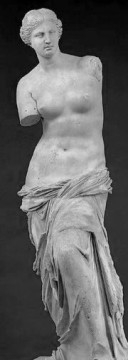
著名的“断臂维纳斯”便是如此.
此外,最美人体的头顶至咽喉的长度与咽喉
至肚脐的长度之比也是$\dfrac{\sqrt5 -1}{2}$,
若某人满足上述两个黄金分割比例,
且腿长为 105 cm,头顶至脖子
下端的长度为 26 cm,则其身高可能是 ( )
$\text{A.}$ $165cm$
$\text{B.}$ $175cm$
$\text{C.}$ $185cm$
$\text{D.}$ $190cm$
关于函数$f(x)=\sin |x|+|\sin x|$有下述四个结论
1.$f(x)$是偶函数
2.$f(x)$在区间 $\left(\frac{\pi}{2}, \pi\right)$ 单调递增
3.$f(x)$在$[-\pi,\pi]$有4个零点。
4.$(f(x)$的最大值为2
其中所有正确的结论编号是
$\text{A.}$ $(1) (2) (4)$
$\text{B.}$ $((2) (4)$
$\text{C.}$ $(1) (4)$
$\text{D.}$ $(1) (3) $
设函数 $f(x)=\frac{1-x}{1+x}$, 则下列函数中为奇函数的是 ( )
$\text{A.}$ $f(x-1)-1$
$\text{B.}$ $\mathrm{f}(\mathrm{x}-1)+1$
$\text{C.}$ $\mathrm{f}(\mathrm{x}+1)-1$
$\text{D.}$ $f(x+1)+1$
函数 $f(x)$ 的定义域为 $R$, 若 $f(x+1)$ 与 $f(x-1)$ 都是奇函数, 则 ( )
$\text{A.}$ $f(x)$ 是偶函数
$\text{B.}$ $f(x)$ 是奇函数
$\text{C.}$ $f(x)=f(x+2)$
$\text{D.}$ $f(x+3)$ 是奇函数
已知命题 $\mathrm{p}_{1}$ :函数 $\mathrm{y}=2^{\mathrm{x}}-2^{-\mathrm{x}}$ 在 $\mathrm{R}$ 为增函数, $\mathrm{p}_{2}$ : 函数 $\mathrm{y}=2^{\mathrm{x}}+2^{-\mathrm{x}}$ 在 $\mathrm{R}$ 为减函数, 则在命题 $\mathrm{q}_{1}: \mathrm{p}_{1} \vee \mathrm{p}_{2}, \mathrm{q}_{2}: \mathrm{p}_{1} \wedge \mathrm{p}_{2}, \mathrm{q}_{3}:\left(\neg \mathrm{p}_{1}\right) \vee \mathrm{p}_{2}$ 和 $\mathrm{q}_{4}: \mathrm{p}_{1} \wedge(\neg$ $\mathrm{p}_{2}$ )中, 真命题是()
$\text{A.}$ $\mathrm{q}_{1}, \mathrm{q}_{3}$
$\text{B.}$ $\mathrm{q}_{2}, \mathrm{q}_{3}$
$\text{C.}$ $\mathrm{q}_{1}, \mathrm{q}_{4}$
$\text{D.}$ $\mathrm{q}_{2}, \mathrm{q}_{4}$
$\left(x+\frac{\mathrm{a}}{\mathrm{x}}\right)\left(2 \mathrm{x}-\frac{1}{\mathrm{x}}\right)^{5}$ 的展开式中各项系数的和为 2 , 则该展开式中常数项 为 ( )
$\text{A.}$ $-40$
$\text{B.}$ $-20$
$\text{C.}$ 20
$\text{D.}$ 40
如图, 网格纸上小正方形的边长为 1, 粗实线画出的是某多面体的 三视图, 则该多面体的各条棱中, 最长的棱的长度为()

$\text{A.}$ $6 \sqrt{2}$
$\text{B.}$ 6
$\text{C.}$ $4 \sqrt{2}$
$\text{D.}$ 4
函数 $f(x)$ 在 $(-\infty,+\infty)$ 单调递减, 且为奇函数. 若 $f(1)=-1$
, 则满足 $-1 \leqslant \mathrm{f}(\mathrm{x}-2) \leqslant 1$ 的 $\mathrm{x}$ 的取值范围是( )
$\text{A.}$ $[-2,2]$
$\text{B.}$ $[-1,1]$
$\text{C.}$ $[0,4]$
$\text{D.}$ $[1,3]$
$\left(x+\frac{y^{2}}{x}\right)(x+y)^{5}$ 的展开式中 $x^{3} y^{3}$ 的系数为
$\text{A.}$ 5
$\text{B.}$ 10
$\text{C.}$ 15
$\text{D.}$ 20
函数 $y=\left(3^{x}-3^{-x}\right) \cos x $ 在区间 $\left[-\frac{\pi}{2}, \frac{\pi}{2}\right] $ 的图像大致为
$\text{A.}$ 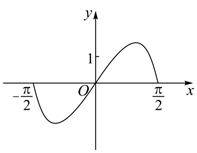 $\text{B.}$
 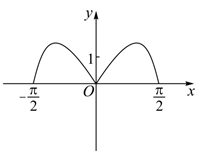 $\text{C.}$
 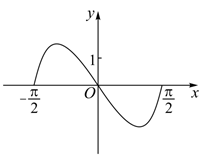 $\text{D.}$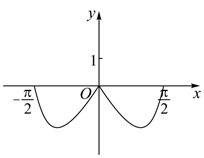
函数 $y=\left(3^{x}-3^{-x}\right) \cos x $ 在区间 $\left[-\frac{\pi}{2}, \frac{\pi}{2}\right] $ 的图像大致为
$\text{A.}$ 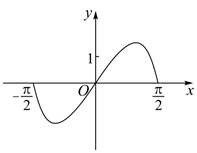 $\text{B.}$
 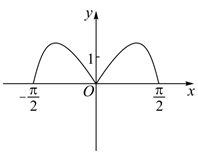 $\text{C.}$
 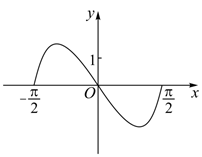 $\text{D.}$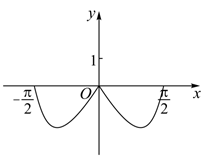
已知 $9^{m}=10, a=10^{m}-11, b=8^{m}-9$, 则 ( )
$\text{A.}$ $a>0>b$
$\text{B.}$ $a>b>0$
$\text{C.}$ $b>a>0$
$\text{D.}$ $b>0>a$
已知函数 $f(x)$ 在 $\mathbf{R}$ 上是单调函数, 且满足对任意 $x \in \mathrm{R}$, 都有 $f\left[f(x)-2^{x}\right]=3$, 则 $f(3)$ 的值是
$\text{A.}$ 3
$\text{B.}$ 7
$\text{C.}$ 9
$\text{D.}$ 12
已知函数 $f(x)=a \ln x-b x^{2}$ 的图象在 $x=1$ 处与直线 $y=-\frac{1}{2}$ 相切, 则函数 $f(x)$ 在 $[1, \mathrm{e}]$ 上的最大值为
$\text{A.}$ $-1$
$\text{B.}$ 0
$\text{C.}$ $-\frac{1}{2}$
$\text{D.}$ 1
若幕函数 $f(x)$ 的图象过点 $(4,2)$, 则 $f(2)$ 的值为
$\text{A.}$ $\frac{1}{2}$
$\text{B.}$ $\frac{\sqrt{2}}{2}$
$\text{C.}$ $\sqrt{2}$
$\text{D.}$ 2
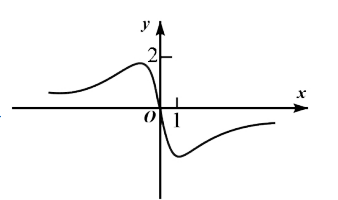
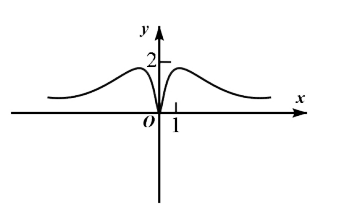
函数 $y=\frac{4 x}{x^{2}+1}$ 的图象大致为()
$\text{A.}$  $\text{B.}$
  $\text{C.}$
  $\text{D.}$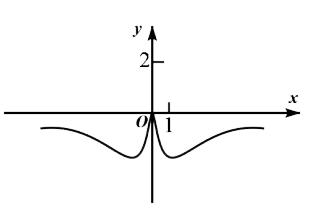
已知函数 $f(x)=\sin \left(x+\frac{\pi}{3}\right)$. 给出下列结论:
(1) $f(x)$ 的最小正周期为 $2 \pi$;
(2) $f\left(\frac{\pi}{2}\right)$ 是 $f(x)$ 的最大值;
(3)把函数 $y=\sin x$ 的图象上所有点向左平移 $\frac{\pi}{3}$ 个单位长度, 可得到函数 $y=f(x)$ 的图象.
其中所有正确结论的序号是
$\text{A.}$ (1)
$\text{B.}$ (1)(3)
$\text{C.}$ (2)(3)
$\text{D.}$ (1)(2)(3)
已知函数 $f(x)=x^{2}$ 的导数为 $f^{\prime}(x)$, 则 $f^{\prime}(1)+f^{\prime}(-1)$ 等于 ()
$\text{A.}$ 0
$\text{B.}$ 1
$\text{C.}$ 2
$\text{D.}$ 4
在同一直角坐标系中, 函数 $y=\frac{1}{a^{x}}, y=\log _{a}\left(x+\frac{1}{2}\right),(a>0$ 且 $a \neq 0)$ 的图像可能是
$\text{A.}$ 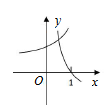 $\text{B.}$
  $\text{C.}$
 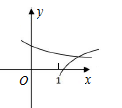 $\text{D.}$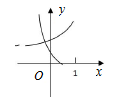
已知 $a, b \in \mathbf{R}$, 函数 $
f(x)=\left\{\begin{array}{l}
x, x < 0 \\
\frac{1}{3} x^{3}-\frac{1}{2}(a+1) x^{2}+a x, x \geq 0
\end{array}\right.
$ 若函数 $ y=f(x)-a x-b $ 恰有三个零点, 则
$\text{A.}$ $a < -1, b < 0$
$\text{B.}$ $a < -1, b>0$
$\text{C.}$ $a>-1, b>0$
$\text{D.}$ $a>-1, b < 0$
若 $a=\lg 0.3, b=\log _{3} 2, c=\log _{5} 4$, 则()
$\text{A.}$ $c>b>a$
$\text{B.}$ $b>c>a$
$\text{C.}$ $c>a>b$
$\text{D.}$ $a>b>c$
已知 $f(x-1)$ 是定义为 $\mathrm{R}$ 上的奇函数, $f(1)=0$, 且 $f(x)$ 在 $[-1,0)$ 上单调递增, 在 $[0,+\infty)$ 上单调递减, 则不等式 $f\left(2^{x}-3\right) < 0$ 的解集为()
$\text{A.}$ $(1,2)$
$\text{B.}$ $(-\infty, 1)$
$\text{C.}$ $(2,+\infty)$
$\text{D.}$ $(-\infty, 1) \cup(2,+\infty)$
已知函数 $f(x)=x-\frac{1}{x}-2 \ln x$, 当 $x>1$ 时, $f\left(x^{2}\right)>8 \lambda f(x)$ 恒成立, 则实数 $\lambda$ 的取值范围为( )
$\text{A.}$ $(-\infty,-2]$
$\text{B.}$ $(-\infty, 2]$
$\text{C.}$ $(-\infty,-1]$
$\text{D.}$ $(-\infty, 1]$
已知函数 $f(x)=\frac{1}{2 x-1}, g(x)=x^{2}-2 x$, 则
$\text{A.}$ $f(x+1)$ 为奇函数, $g(x-1)$ 为偶函数
$\text{B.}$ $f(x+1)$ 为奇函数,$g(x+1)$ 为偶函数
$\text{C.}$ $f\left(x+\frac{1}{2}\right)$ 为奇函数, $g(x-1)$ 为偶函数
$\text{D.}$ $f\left(x+\frac{1}{2}\right)$ 为奇函数, $g(x+1)$ 为偶函数
已知函数 $y=f(x+1)$ 的图象关于直线 $x=-3$ 对称, 且对 $\forall x \in \mathbf{R}$ 都有 $f(x)+f(-x)=$ 2. 当 $x \in(0,2]$ 时, $f(x)=x+2$. 则 $f(2022)=$
$\text{A.}$ $-1$
$\text{B.}$ $1$
$\text{C.}$ $2$
$\text{D.}$ $-2$
已知 $f(x)=|\lg x|-c$ 有两个下不同零点 $a, b$, 则下列结论成立的是
$\text{A.}$ $a^2+b^2$ 最小值为 2
$\text{B.}$ $a+b$ 最小值为 2
$\text{C.}$ $4 a^2+b^2$ 最小值为 4
$\text{D.}$ $a^2+b^2-a b$ 最小值为 1
已知函数 $f(x)$ 的定义域为 $R$, 且 $f(m+n)+f(m-n)=f(m) f(n), f(1)=1(m, n \in R)$, 则 $\sum_{i=1}^{20} f(i)=$
$\text{A.}$ 0
$\text{B.}$ 1
$\text{C.}$ -2
$\text{D.}$ -3
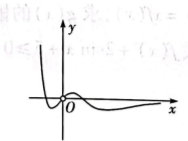
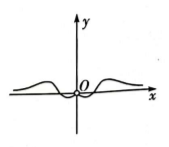
函数 $f(x)=\frac{x^2 \ln |x|}{\mathrm{e}^x}$ 的部分图象大致为
$\text{A.}$ 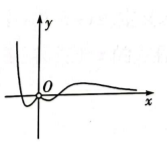 $\text{B.}$
  $\text{C.}$
  $\text{D.}$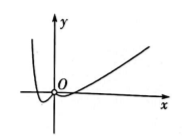
已知定义域为 $(0,+\infty)$ 的函数 $f(x)$ 的导函数为 $f^{\prime}(x)$, 且函数 $g(x)=\left(\log _3 x-1\right) \cdot f^{\prime}(x)$ 的部分图象如图所示, 则下列说法中正确的是
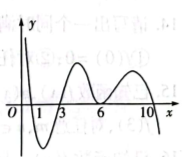
$\text{A.}$ $f(x)$ 有极小值 $f(6)$, 极大值 $f(1)$
$\text{B.}$ $f(x)$ 有极小值 $f(6)$, 极大值 $f(10)$
$\text{C.}$ $f(x)$ 有极小值 $f(1)$, 极大值 $f(3)$ 和 $f(10)$
$\text{D.}$ $f(x)$ 有极小值 $f(1)$, 极大值 $f(10)$
若函数 $f(x)=\left(x^2-a x-2\right) \mathrm{e}^{x+1}$ 有两个极值点且这两个极值点互为相反数, 则 $f(x)$ 的极小 值为
$\text{A.}$ $-6 \mathrm{e}^3$
$\text{B.}$ $-2 \mathrm{e}^3$
$\text{C.}$ $-4 \mathrm{e}$
$\text{D.}$ $-\frac{2}{\mathrm{e}}$
已知 $f(x)=x^3+b x^2+x+d, b 、 d \in R$, 下列说法正确的是
$\text{A.}$ 存在 $b, d$ 使得 $f(x)$ 是奇函数
$\text{B.}$ 任意 $b 、 d, f(x)$ 的图像是中心对称图形
$\text{C.}$ 若 $x_1, x_2$ 为 $f(x)$ 的两个极值点, 则 $x_1{ }^2+x_2{ }^2>1$
$\text{D.}$ 若 $f(x)$ 在 $R$ 上单调, 则 $-\sqrt{3} \leq b \leq \sqrt{3}$
已知函数 $f(x)$ 及其导函数 $f^{\prime}(x)$ 的定义域均为 $\mathbf{R}$, 若 $f^{\prime}(x)-f(x)=\dfrac{x-\sin x}{\mathrm{e}^x}, f(0)=1$, 则下列结论正确的是
$\text{A.}$ $f(1)>\mathrm{e}$
$\text{B.}$ $f^{\prime}\left(\frac{\pi}{2}\right) < f\left(\frac{\pi}{2}\right)$
$\text{C.}$ 方程 $f^{\prime}(x)=f(x)+\frac{1}{2 \mathrm{e}^2}$ 有两个解
$\text{D.}$ $f(x)$在$(0, \dfrac{\pi}{2})$ 上单调递增
已知函数 $f(x)=a x^3+b x+2(a \neq 0)$ 满足 $f(-3)=5$, 则 $f(3)$ 等于
$\text{A.}$ $2$
$\text{B.}$ $-5$
$\text{C.}$ $-1$
$\text{D.}$ $-3$