单选题 (共 24 题 ),每题只有一个选项正确
设函数 $f(x)=\left\{\begin{array}{c}\sin x, 0 \leq x < \pi \\ 2, \pi \leq x \leq 2 \pi\end{array}, \quad F(x)=\int_0^x f(t) \mathrm{d} t\right.$ ,则
$\text{A.}$ $\boldsymbol{x}=\pi$ 为函数 $\boldsymbol{F}(\boldsymbol{x})$ 的跳跃间断点
$\text{B.}$ $\boldsymbol{x}={\pi}$ 为函数 $\boldsymbol{F}(\boldsymbol{x})$ 的可去间断点
$\text{C.}$ $\boldsymbol{F}(x)$ 在 $\boldsymbol{x}=\pi$ 连续但不可导
$\text{D.}$ $F(x)$ 在 $x=\pi$ 可导
设函数 $f(x)=\left\{\begin{array}{cl}x^\alpha \cos \frac{1}{x^\beta}, & x>0 \\ 0, & x \leq 0\end{array}(\alpha>0, \beta>0)\right.$ ,若 $f^{\prime}(x)$ 在 $x=0$ 处连续,则
$\text{A.}$ $\alpha-\beta>1$
$\text{B.}$ $0 < \alpha-\beta \leq 1$
$\text{C.}$ $\alpha-\beta>2$
$\text{D.}$ $0 < \alpha-\beta \leq 2$
已知函数 $f(x)=\left\{\begin{array}{l}x, x \leq 0, \\ \frac{1}{n}, \frac{1}{n+1} < x \leq \frac{1}{n}, n=1,2, \cdots\end{array}\right.$ 则
$\text{A.}$ $x=0$ 是 $f(x)$ 的第一类间断点
$\text{B.}$ $x=0$ 是 $f(x)$ 的第二类间断点
$\text{C.}$ $f(x)$ 在 $x=0$ 处连续但不可导
$\text{D.}$ $f(x)$ 在 $x=0$ 处可导
设函数 $f(x)$ 在 $(-\infty,+\infty)$ 内连续,其导函数的图形如图所示, 则
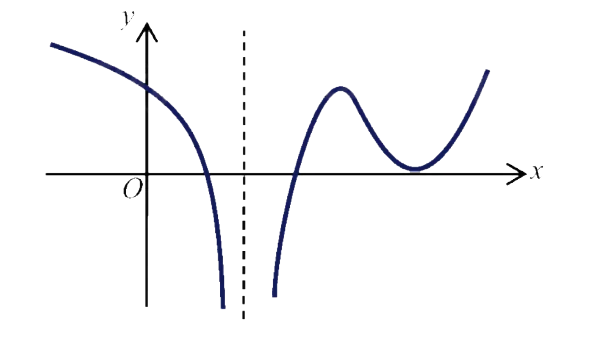
$\text{A.}$ 函数 $f(x)$ 有 2 个极值点,曲线 $y=f(x)$ 有 2 个拐点
$\text{B.}$ 函数 $f(x)$ 有 2 个极值点,曲线 $y=f(x)$ 有 3 个拐点
$\text{C.}$ 函数 $f(x)$ 有 3 个极值点,曲线 $y=f(x)$ 有 1 个拐点
$\text{D.}$ 函数 $f(x)$ 有 3 个极值点,曲线 $y=f(x)$ 有 2 个拐点
函数 $f(x)=\left\{\begin{array}{cl}\frac{\mathrm{e}^x-1}{x}, & x \neq 0 \\ 1, & x=0\end{array}\right.$ 在 $x=0$ 处 ( )
$\text{A.}$ 连续且取极大值
$\text{B.}$ 连续且取极小值
$\text{C.}$ 可导且导数等于 0
$\text{D.}$ 可导且导数不为 0
已知函数 $f(x, y)=\ln (y+|x \sin y|)$ ,则 ( )
$\text{A.}$ $\left.\frac{\partial f}{\partial x}\right|_{(0,1)}$ 不存在, $\left.\frac{\partial f}{\partial y}\right|_{(0,1)}$ 存在
$\text{B.}$ $\left.\frac{\partial f}{\partial x}\right|_{(0,1)}$ 存在, $\left.\frac{\partial f}{\partial y}\right|_{(0,1)}$ 不存在
$\text{C.}$ $\left.\frac{\partial f}{\partial x}\right|_{(0,1)},\left.\frac{\partial f}{\partial y}\right|_{(0,1)}$ 均存在
$\text{D.}$ $\left.\frac{\partial f}{\partial x}\right|_{(0,1)},\left.\frac{\partial f}{\partial y}\right|_{(0,1)}$ 均不存在
设非负函数 $f(x)$ 在 $[0,+\infty)$ 上连续,给出以下三个命题:
(1) 若 $\int_0^{+\infty} f^2(x) \mathrm{d} x$ 收敛,则 $\int_0^{+\infty} f(x) \mathrm{d} x$ 收敛。
(2) 若存在 $p>1$ ,使得 $\lim _{x \rightarrow+\infty} x^p f(x)$ 存在,则 $\int_0^{+\infty} f(x) \mathrm{d} x$ 收敛.
(3) 若 $\int_0^{+\infty} f(x) \mathrm{d} x$ 收敛,则存在 $p>1$ ,使得 $\lim _{x \rightarrow+\infty} x^p f(x)$ 存在.其中真命题的个数为()
$\text{A.}$ 0
$\text{B.}$ 1
$\text{C.}$ 2
$\text{D.}$ 3
设函数 $f(x)=\lim _{n \rightarrow \infty} \frac{1+x}{1+n x^{2 n}}$ ,则 $f(x)(\quad)$
$\text{A.}$ 在 $x=1, x=-1$ 处都连续
$\text{B.}$ 在 $x=1$ 处连续, $x=-1$ 处不连续
$\text{C.}$ 在 $x=1, x=-1$ 处都不连续
$\text{D.}$ 在 $x=1$ 处不连续, $x=-1$ 处连续
设 $f(x)=\int_0^{|\sin x|} e ^{t^2} d t, g(x)=\int_0^{|x|} \sin t^2 d t$, 则在 $(-\pi, \pi)$ 内,
$\text{A.}$ $f(x)$ 是可导的奇函数.
$\text{B.}$ $g(x)$ 是可导的偶函数。
$\text{C.}$ $f(x)$ 是奇函数且 $f^{\prime}(0)$ 不存在。
$\text{D.}$ $g(x)$ 是偶函数且 $g^{\prime}(0)$ 不存在.
设 $f(x)=\int_0^{|\sin x|} e ^{t^2} d t, g(x)=\int_0^{|x|} \sin t^2 d t$, 则在 $(-\pi, \pi)$ 内,
$\text{A.}$ $f(x)$ 是可导的奇函数.
$\text{B.}$ $g(x)$ 是可导的偶函数.
$\text{C.}$ $f(x)$ 是奇函数且 $f^{\prime}(0)$ 不存在.
$\text{D.}$ $g(x)$ 是偶函数且 $g^{\prime}(0)$ 不存在.
设函数 $y=f(x)$ 在点 $x=0$ 处连续,则下列命题中,错误的是( )
$\text{A.}$ 若 $\lim _{x \rightarrow 0} \frac{f(x)}{x}=a$, 则 $f^{\prime}(0)=a$.
$\text{B.}$ 若 $f(0)=0, f^{\prime}(0)=a$, 则 $\lim _{x \rightarrow 0} \frac{f(x)}{x}=a$.
$\text{C.}$ 若 $\lim _{x \rightarrow 0} \frac{f(x)}{x^2}=\frac{a}{2}$, 则 $f^{\prime \prime}(0)=a$.
$\text{D.}$ 若 $f(0)=f^{\prime}(0)=0, f^{\prime \prime}(0)=a$, 则 $\lim _{x \rightarrow 0} \frac{f(x)}{x^2}=\frac{a}{2}$.
设函数 $f(x)$ 在区间 $[0,+\infty)$ 上可导, 则
$\text{A.}$ 当 $\lim _{x \rightarrow+\infty} f(x)$ 存在时, $\lim _{x \rightarrow+\infty} f^{\prime}(x)$ 存在
$\text{B.}$ 当 $\lim _{x \rightarrow+\infty} f^{\prime}(x)$ 存在时, $\lim _{x \rightarrow+\infty} f(x)$ 存在
$\text{C.}$ 当 $\lim _{x \rightarrow+\infty} \frac{\int_0^x f(t) d t}{x}$ 存在时, $\lim _{x \rightarrow+\infty} f(x)$ 存在.
$\text{D.}$ 当 $\lim _{x \rightarrow+\infty} f(x)$ 存在时, $\lim _{x \rightarrow+\infty} \frac{\int_0^x f(t) d t}{x}$ 存在.
已知函数 $f(x)=\left\{\begin{array}{ll}\varphi(x), & x \geqslant 0, \\ \phi(x), & x < 0,\end{array}\right.$ 极限 $\lim _{x \rightarrow 0} \frac{f(x)-\varphi(0)}{x}=A$(常数),其中可导函数 $\varphi(x)$, $\phi(x)$ 满足 $\varphi^{\prime}(0) \leqslant 0, \phi^{\prime}(0) \geqslant 0$ ,下列说法
(1)$f(x)$ 在 $x=0$ 处连续;(2)$A=0$ ;(3) $\lim _{x \rightarrow 0} f^{\prime}(x)=0$ ;(4)$x=0$ 是 $f(x)$ 的极小值点.正确的个数为().
$\text{A.}$ 1
$\text{B.}$ 2
$\text{C.}$ 3
$\text{D.}$ 4
已知 $f(x)=\frac{\ln \left(1+x^3\right)}{x-|\ln (1+x)|} \cdot \frac{ e ^{\frac{1}{x-1}}+ e ^{x-1}}{ e ^{\frac{1}{x-1}}- e ^{x-1}}$ ,则下列说法正确的是 $(\quad)$ .
$\text{A.}$ $f(x)$ 有一个跳跃间断点,一个可去间断点和一个无穷间断点
$\text{B.}$ $F_1(x)=\left\{\begin{array}{ll}f(x), & x \neq 0 \text { 且 } x \neq 1, \\ 1, & x=0 \text { 或 } x=1\end{array}\right.$ 在闭区间 $\left[-\frac{1}{2}, \frac{3}{2}\right]$ 上有界
$\text{C.}$ $F_1(x)=\left\{\begin{array}{ll}f(x), & x \neq 0 \text { 且 } x \neq 1, \\ 1, & x=0 \text { 或 } x=1\end{array}\right.$ 在开区间 $\left(-\frac{1}{2}, \frac{3}{2}\right)$ 内不可积
$\text{D.}$ 记 $F(x)=\int_0^x f(t) d t$ ,则 $F(x)$ 在开区间 $\left(-1, \frac{1}{2}\right)$ 内可导
下列说法正确的是( ).
$\text{A.}$ 若数列 $\left\{x_n\right\}$ 有界,且 $\lim _{n \rightarrow \infty}\left(x_{n+1}-x_n\right)=0$ ,则数列 $\left\{x_n\right\}$ 收敛
$\text{B.}$ 若 $\lim _{n \rightarrow \infty} x_{2 n}=a, \lim _{n \rightarrow \infty}\left(x_{n+1}-x_n\right)=0$ ,则 $\lim _{n \rightarrow \infty} x_n=a$
$\text{C.}$ 若数列 $\left\{x_n\right\}$ 单调,数列 $\left\{x_{2 n}\right\}$ 收敛,则数列 $\left\{x_n\right\}$ 不一定收敛
$\text{D.}$ 若数列 $\left\{x_n\right\}$ 的任何子列都收敛,则数列 $\left\{x_n\right\}$ 不一定收敛
设 $x_n=\frac{2}{n}+(-1)^n e ^{(-1)^n n}$ ,则数列 $\left\{x_n\right\}(\quad)$
$\text{A.}$ 有下界,但没有最小值
$\text{B.}$ 有下界且有最小值
$\text{C.}$ 有上界,但没有最大值
$\text{D.}$ 有上界且有最大值
设函数 $f(x)$ 在 $x=\frac{\pi}{2}$ 处连续,且 $\lim _{x \rightarrow \frac{\pi}{2}} \frac{f(x)}{|\cos x|}=1$ ,则()
$\text{A.}$ $\lim _{x \rightarrow \frac{\pi}{2}} f^{\prime}(x)=1$ .
$\text{B.}$ $f(x)$ 在 $x=\frac{\pi}{2}$ 处可导.
$\text{C.}$ $f(x)$ 在 $x=\frac{\pi}{2}$ 处的左导数为 1 .
$\text{D.}$ $f(x)$ 在 $x=\frac{\pi}{2}$ 处的右导数为 1 .
设 $f(x)$ 在 $(-\infty,+\infty)$ 上连续,$T$ 为一常数,则下列命题中错误的是
$\text{A.}$ 对于任意的 $a, \int_{-a}^a f(x) \mathrm{d} x=0 \Leftrightarrow f(-x)=-f(x)$ .
$\text{B.}$ 对于任意的 $a, \int_{-a}^a f(x) \mathrm{d} x=2 \int_0^a f(x) \mathrm{d} x \Leftrightarrow f(-x)=f(x)$ .
$\text{C.}$ 对于任意的 $a, \int_a^{a+T} f(x) \mathrm{d} x$ 与 $a$ 无关 $\Leftrightarrow f(x)$ 有周期为 $T$ .
$\text{D.}$ $f(x+T)=f(x) \Leftrightarrow \int_a^x f(x) \mathrm{d} x$ 以 $T$ 为周期.
设函数 $f(x, y)=\left\{\begin{array}{ll}\frac{x y}{|x|^m+|y|^n}, & x^2+y^2 \neq 0, \\ 0, & x^2+y^2=0,\end{array}\right.$ 其中 $m, n$ 是两个正整数,则 $f(x, y)$ 在 $(0,0)$ 处不连续的充要条件是
$\text{A.}$ $m>2$ 且 $n>2$ .
$\text{B.}$ $m \geqslant 2$ 且 $n>2$ .
$\text{C.}$ $m>2$ 且 $n \geqslant 2$ .
$\text{D.}$ $m \geqslant 2$ 且 $n \geqslant 2$ .
下列说法正确的个数是( )
(1)若 $\lim _{x \rightarrow 0} f(x)=0$ ,则 $\lim _{x \rightarrow 0} f(x) \sin \frac{1}{x}=0$ ;
(2)若 $\lim _{x \rightarrow 0} f(x) \sin \frac{1}{x}=0$ ,则 $\lim _{x \rightarrow 0} f(x)=0$ ;
(3)若 $f(x)$ 在 $x=0$ 的去心邻域内无界,则 $f(x) \sin \frac{1}{x}$ 在 $x=0$ 的去心邻域内无界;
(4)若 $f(x) \sin \frac{1}{x}$ 在 $x=0$ 的去心邻域内无界,则 $f(x)$ 在 $x=0$ 的去心邻域内无界。
$\text{A.}$ 1.
$\text{B.}$ 2 .
$\text{C.}$ 3.
$\text{D.}$ 4 .
设 $a_n>0(n=1,2,3 \cdots), S_n=a_1+a_2+a_3+\cdots+a_n$ ,则数列 $\left\{S_n\right\}$ 有界是数列 $\left\{a_n\right\}$ 收敛的
$\text{A.}$ 充分必要条件.
$\text{B.}$ 充分非必要条件.
$\text{C.}$ 必要非充分条件.
$\text{D.}$ 非充分也非必要.
设函数 $f(x, y)=\left\{\begin{array}{ll}\frac{x y}{|x|^m+|y|^n}, & x^2+y^2 \neq 0, \\ 0, & x^2+y^2=0,\end{array}\right.$ 其中 $m, n$ 是两个正整数,则 $f(x, y)$ 在 $(0,0)$ 处不连续的充要条件是
$\text{A.}$ $m>2$ 且 $n>2$ .
$\text{B.}$ $m \geqslant 2$ 且 $n>2$ .
$\text{C.}$ $m>2$ 且 $n \geqslant 2$ .
$\text{D.}$ $m \geqslant 2$ 且 $n \geqslant 2$ .
设 $f(x)=\left\{\begin{array}{ll}x^\alpha \sin \frac{1}{x^\beta}, & x \neq 0, \\ 0, & x=0\end{array}\right.$ 在 $x=0$ 处连续,则 $\alpha, \beta$ 满足条件
$\text{A.}$ $\alpha>0, \beta>0$ .
$\text{B.}$ $\alpha < 0, \beta < 0$ .
$\text{C.}$ $\alpha>0$ ,或 $\beta < 0$ 且 $\alpha-\beta>0$ .
$\text{D.}$ $\alpha>0, \alpha-\beta < 0$ .
设函数 $f(x, y)=\left\{\begin{array}{ll}\frac{x y}{|x|^m+|y|^n}, & x^2+y^2 \neq 0, \\ 0, & x^2+y^2=0,\end{array}\right.$ 其中 $m, n$ 是两个正整数,则 $f(x, y)$ 在 $(0,0)$ 处不连续的充要条件是
$\text{A.}$ $m>2$ 且 $n>2$ .
$\text{B.}$ $m \geqslant 2$ 且 $n>2$ .
$\text{C.}$ $m>2$ 且 $n \geqslant 2$ .
$\text{D.}$ $m \geqslant 2$ 且 $n \geqslant 2$ .